
Homily of Fr. Jorge William Hernández SJ, new Provincial of the Caribbean, on the solemnity of Saint Ignatius of Loyola.
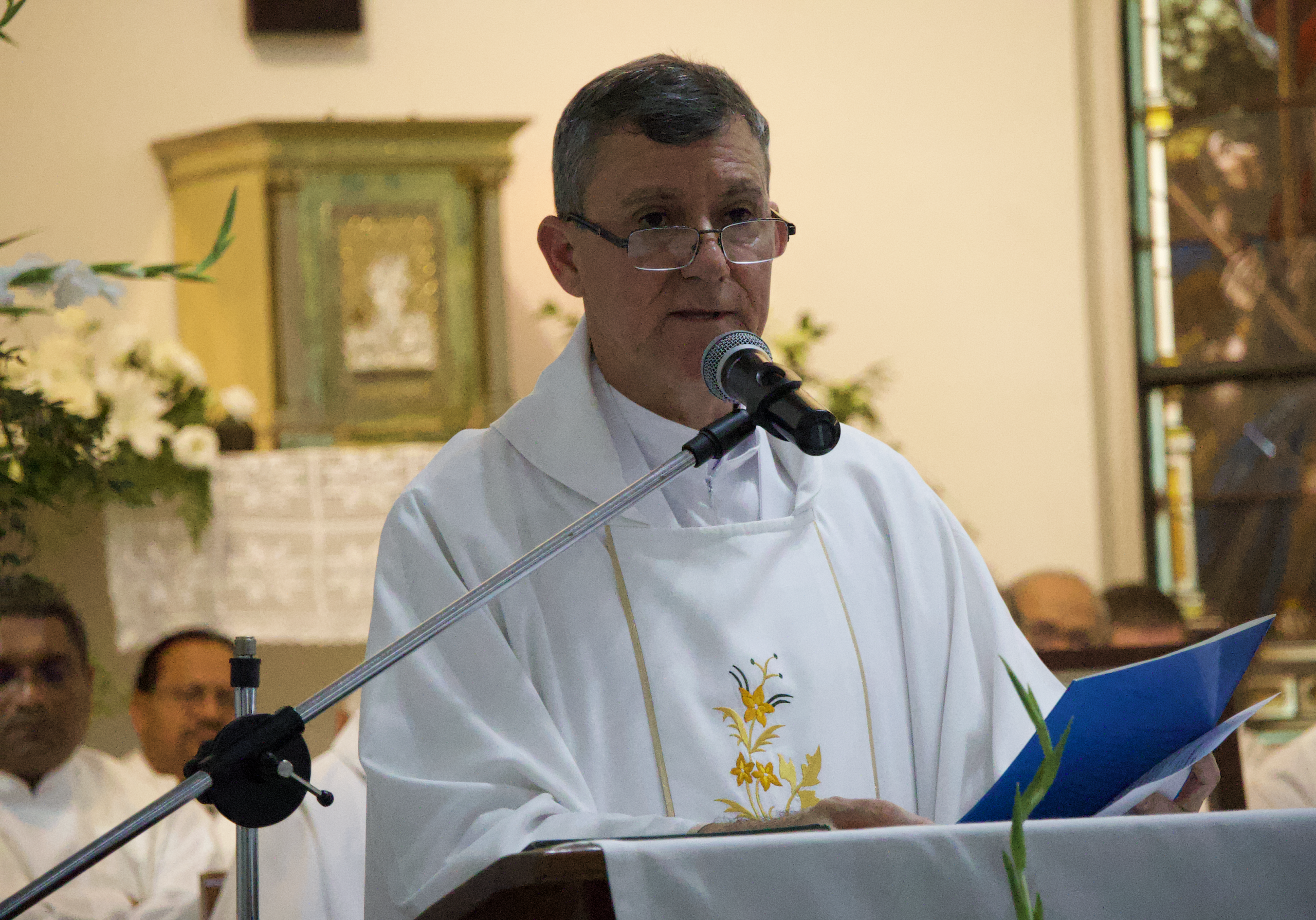
Homily of Fr. Jorge William Hernández SJ, new Provincial of the Caribbean, on the solemnity of Saint Ignatius of Loyola.
Solemnity of Saint Ignatius of Loyola
July 31, 2026 — Santo Domingo
Jesuit Province of the Caribbean
Sisters and brothers:
Each year, July 31st brings to mind the feast of Saint Ignatius of Loyola. It is a day when the entire family sharing Ignatian spirituality gathers to give thanks to God and renew our fraternity as friends in the Lord and companions in the mission. This year, moreover, we give thanks to God for the faithful and generous service of Fr. Martín Lenk, SJ, who has generously served as provincial for six years.
The readings help us tune into Ignacio's life and his legacy as an older brother who showed us a possible path to finding God. They underline the meaning of knowing we are called, the often costly nature of following Jesus, and, not least importantly, where the source of strength to follow that path lies.
Saint Ignatius of Loyola, God found him little by little, from the wound in Pamplona, his convalescence in his homeland, in a cave in Manresa, in hospitals, in universities, on the roads of the Holy Land. He was transformed into someone who stopped seeking his own glory to, amidst quicksand, find the greater glory of God. I wish to quote Pope Leo in his speech to the authorities during his apostolic visit to Spain in June 2026:
As another noble son of this land has taught us through trials and failures, it is possible to rethink everything. Ignatius of Loyola had this audacity, giving credit to the desolations and consolations of his heart. In an exercise of discernment and imagination, whereby he preferred peace to arms and saints to the powerful, he understood that the good to which he felt drawn was not utopian, and thus his crisis was transformed into grace.
He presented him as an example of spiritual resilience, one who did not let himself be sunk by adversity, but rather as one who let himself be molded by grace and overcomes crises.
I. A fire that burns from within
In the first reading, we find one of the pillars of our spirituality from the hand of the prophet Jeremiah: the confession, “You seduced me, Lord, and I let myself be seduced.” A phrase that remains a great challenge for us today. The prophet does not speak of a serene and orderly vocation. He speaks of a struggle, of an inner combat: “but there was in me a burning fire, shut up in my bones; I struggled to hold it in, but could not.”.
Íñigo de Loyola also had this same experience of the inner fire that the prophet speaks of. As I said before, it wasn't all at once, but little by little. While recovering from his wounds in Loyola, he began to notice something: fantasies of chivalry and human glory generated enthusiasm in him, but then left him empty. On the other hand, when he imagined following Christ and serving the poor, he felt a peace that remained. That contrast was the first experience of discernment in his life. God was seducing him from within.
Today God continues to seduce hearts, as He seduced those of Jeremiah and Ignatius, which is why we can continue to ask ourselves: What fire do we carry within? That fire, when it comes from God, does not go out; we can often try to extinguish it, but sooner or later it burns.
II. Discern from the Love Received
In the Gospel we have heard, Jesus speaks of renunciation: of family, possessions, and even oneself. But the spirit of the teaching is not renunciation for its own sake. It is the wisdom, temperance, and sensitivity of the Kingdom. Following Christ is not reduced to an emotional impulse; it is a decision made with open eyes. In the Spiritual Exercises, as we have also experienced, one does not try to guess God's will. It is a process of ordering one's affections, examining one's inner stirrings, and deliberating with freedom. Ignatian discernment takes precisely what Jesus proposes in the Gospel: the clarity that precedes commitment.
In this same spirit, Saint Paul, in his letter to the Corinthians, states it with a firmness that often disarms us: “Whatever you do, whether eating or drinking, or anything else, do it all for the glory of God.” This is the motto that Ignatius would make the heart of his spirituality: For the greater glory of God For the greater glory of God. AMDG.
Perhaps today it's important to understand what that doesn't mean. It doesn't mean grandiosity, nor does it mean spectacular works or monumental projects. It means orientation. Eating can be for the glory of God, drinking can be for the glory of God, accompanying a province can be for the glory of God, cleaning a kitchen in a community can be for the glory of God. What matters is not the magnitude of the action, but the direction of the heart.
III. An Apostolic Body and a Plural Mission
There is something that this celebration makes visible in a special way. Let's look around. This eucharist brings us together as friends in the Lord of the Society from Guyana, Jamaica, Trinidad and Tobago, Cuba, Miami, Haiti, and the Dominican Republic. Different languages, cultures, and mission contexts. And yet, a single apostolic body. Our Caribbean region has many common challenges, and some particular ones as well. Uniformity is not so important, but rather unity: love for Christ, availability for mission, obedience to the Spirit. And the task for all of us is to be that generous, available, and united body.
Let us seek the consolation that does not deceive, let us return to the beginning. “You seduced me, Lord, and I let myself be seduced.” There is something profoundly Ignatian in those words of Jeremiah. Ignatius discovered that God acts by attraction. That the Holy Spirit works from within, generating desires, affections, consolations that lead towards good. The consolation that comes from God has a characteristic: it generates lasting fruits. It leaves no emptiness. It does not produce anxiety or pride. It leaves humility, peace, charity, a desire to serve.
To finish
Sisters and brothers, the feast of St. Ignatius is not the celebration of a glorious past. It is a question directed to each of us in the present. Where is that fire in my life? How clearly am I taking into account the cost of following Christ? Is my life oriented toward the greater glory of God? Am I truly part of an apostolic body, or do I move as a solitary individual? And do I know how to recognize the consolation that comes from God and that which does not?
Ignacio answered those questions with his life. Not all at once, but day by day, in the examination of conscience he practiced until the end. And that is, perhaps, his greatest legacy: not a method, not an elite spirituality, but an attitude—that of someone who lives with open eyes, attentive to the movements of the Spirit, available to be sent.
May it be said of us as Jeremiah confessed: that we tried to silence the fire, but we could not. Because it was from God.
Finally, I want us to entrust and give thanks today to Fr. Martin Lenk for years of service oriented in that direction. A Province is not accompanied without wear and tear, without tensions, without nights of uncertainty. Accompanying for the greater glory of God means precisely that: that even in wear and tear, the compass points to the same north.
For the greater glory of God.
P. JORGE WILLIAM HERNÁNDEZ, SJ

Recent news
Welcoming, protecting and accompanying children and adolescents in mobility: 112th World Day of Migrants and Refugees.
Letter from the Provincial Fr. Jorge William Hernández, SJ to the Caribbean Educational Network for the start of the 2026-2027 academic year.